

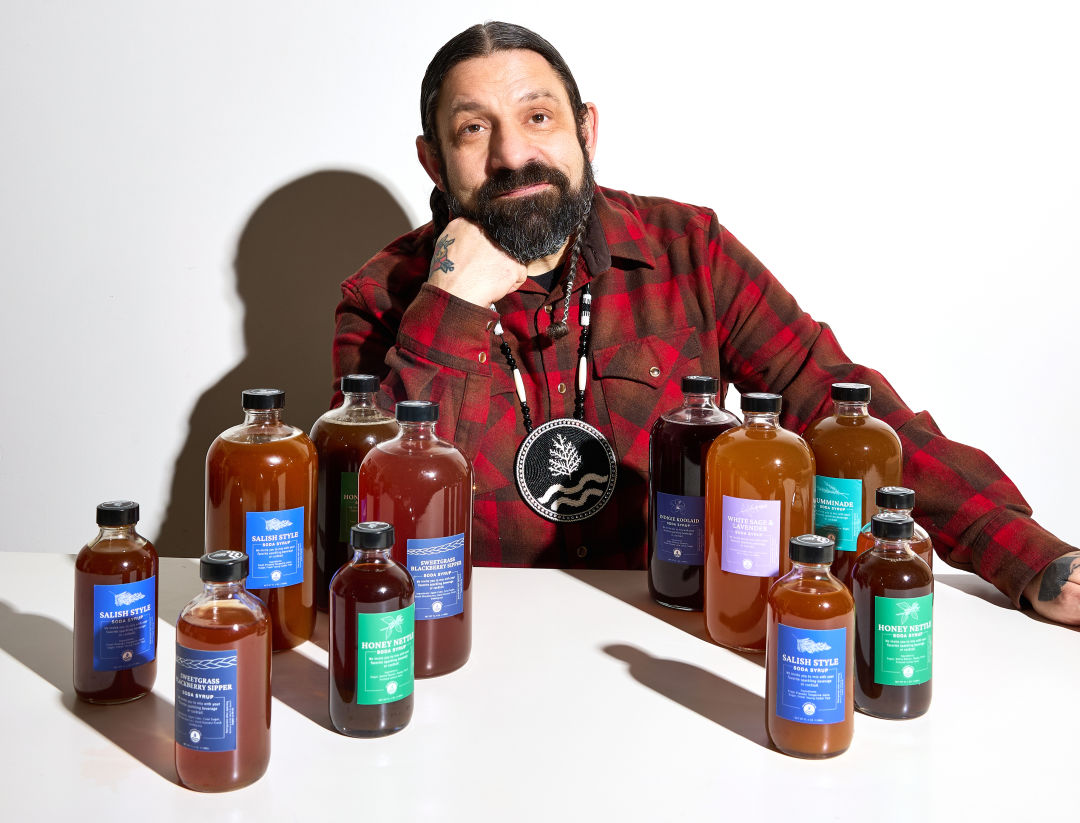
Jason Vickers named his company after his mission; Natoncks Metsu means “feeding my cousins.”
Beneath the citrus brightness of fresh tangerine juice in Salish Style soda syrup lies the absinthe-like complexity of young cedar tips. Stir it into sparkling water and the taste is celebratory: a drink apt for a toast. The drink itself is a victory—the product of Jason Vickers’s long journey back from rock bottom, and the community that helped him get there.
Vickers gave himself over to the police in the parking garage behind Hot Mama’s Pizza on a November night in 2016. Vickers grew up in Seattle, wandering the Pike Place Market, later cooking at restaurants like Café Campagne. He worked in catering, thrilled with the idea of going to parties for a living. But after his mom passed away he struggled to care for himself. He briefly ran a successful food truck, Fez on Wheels, even as his dependence on drugs deepened and he experienced houselessness. And so, finally, he stopped running. He had a felony warrant out for his arrest, and, after years of struggling with addiction and substance abuse, he was exhausted.

Indigenous ingredients and inspiration flavor Natoncks Metsu's soda syrups.
In prison, Indigenous fellow inmates embraced Vickers and connected him to the culture he never really knew growing up. Vickers comes from the Hassanamisco Band of Nipmuc Nation, whose land is around Worcester, Massachusetts, where he was born. “I grew up as an urban Native, very disconnected from that in most of my life,” Vickers says. His few experiences with food at powwows mostly involved canned sodas, hot dogs, and chips.
“The Indigenous world had been hungry for education, conversation, and the serving of traditional foods,” he says. And when Vickers left prison, he wanted to cook just that. At the Paddle to Lummi (a large gathering of local Indigenous groups) in 2019, he took inspiration from a time he had mistakenly oversweetened a raspberry rosemary sorbet to the point that it wouldn’t freeze, so he added it to club soda instead. That idea—infused with plants used in Indigenous foodways—became Salish Style, his first soda syrup, and it was a hit at the event.

Foraging changed Vickers's relationship with nature, and foraged ingredients power his syrups.
He named the company after his mission: Natoncks Metsu, or “feeding my cousins” in Nipmuc. Since leaving incarceration, he had learned to forage, which transformed Vickers’s relationship with nature. “It’s the same woods. It’s just a whole different place,” he says. “When it was time to rejuvenate and create a new life, I was given this incredible gift of all of these traditional ingredients that come with their own stories, their own medicinal properties, their own traditions.” He steeps fresh cedar tips for the Enchanted Forest soda syrup, and the water from blanching the great quantity of nettles he gathers each spring for pesto goes into the Honey Nettle flavor.
The simple syrup–based mixes work well with still or sparkling water, or even stirred into a hot cider in winter. Rainier Beach’s zero- and low-proof bar Rosette uses a lavender–white sage syrup in its sage old-fashioned, and the Salish Lodge—owned by the Snoqualmie since 2019—uses the Indigie Koolaid for its hibiscus spritz, and sells the syrups in its gift shop. Vickers now makes seven flavors, including rosemary-lemon Lumminade, honoring the event that inspired him. “As Indigenous people, the moment of reawakening someone’s relationship to these plant medicines, and watching it happen, is absolutely magical,” he says. “We use our traditional plant medicine to smudge, to clean ourselves, to refresh ourselves and this is literally just another way to do just that.”