


Summit at Snoqualmie's Central area closed temporarily until conditions improve.
There's nothing sadder than a warm, sunny day in winter, at least to a skier. Well, maybe a warm, rainy day in Seattle winter is worse. Because either one of those mean one thing to the ski-obsessed: There's no new snow in the mountains.
The 2025–26 ski season started out cursed. An early December flooding event wreaked havoc on Washington highways, washing out the routes to Crystal Mountain and Stevens Pass, two of the biggest ski destinations from Seattle. Summit at Snoqualmie, its freeway approach intact, lost all its early season snowfall to the deluge.
But answered prayers to the WSDOT gods—and a dollop of emergency funding—meant that roads, at least from the Seattle side of the passes, were quickly repaired. For a week or two, it looked like the ski season would be merely a late bloomer.
But then Dry January hit. Worse than just dry, it was interspersed with atmospheric rivers dumping warm, wet precipitation on an already meager snowpack. Much of the white stuff simply washed away. By the last weekend of January, even Crystal Mountain's upper runs were smeared with brown dirt kicked up by the grooming machines, and speckled with fist-size rocks. It's bleak out there.
“We need more snow, don't we?” says Michael Fagin, a meteorologist for Powder Poobah, a Seattle-based ski forecast newsletter. That's an understatement. The current Western Washington snowpack is at about 50 percent of normal. Oregon is even worse, hovering around 20 percent.
But as Fagin points out, anyone wailing about worst-ever status has a short memory. “If you put in the perspective of 2015,” this season isn't so horrifying, he says. “Most areas at this point in time were 20 percent of normal. That was just probably one of the worst recent snowpack years we've had.”
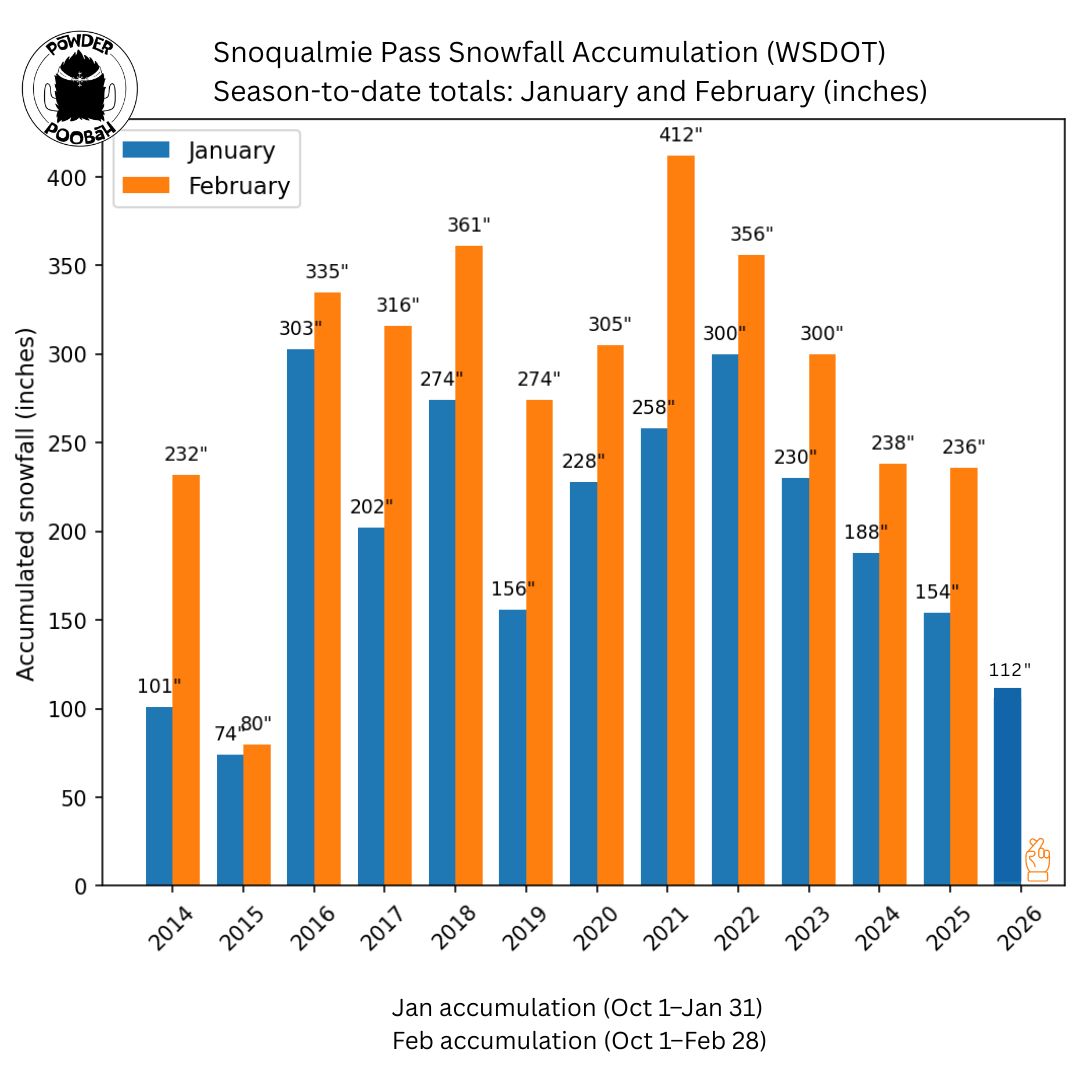
Back then, news reports called it “dismal” and “lean.” Stevens Pass was open only 87 days (normal then was 130), and revenues were down 43 percent, according to Everett Herald reporting. But even that seemed healthy compared to 2004–5, when Stevens was open for just 46 days. About once a decade, the Cascades break our hearts.
But what has changed are the multi-mountain season passes and big corporate ownership; since the last bad year, Stevens Pass was sold to Vail Resorts and Crystal Mountain was sold to Alterra Mountain Resort; Summit at Snoqualmie was fully acquired by Michigan-based Boyne Resorts.
While such consolidation can alleviate the effects of one bad season in one region of the US, it doesn't help when most of a company's holdings are suffering. Vail Resorts already reported almost $200 million in net losses in late 2025. (Park City is, uh, brown city right now, the worst year since they began recording.)
Who's to blame? New England. Yes, sorta. Just in time for the Seahawks to play the Patriots in the Super Bowl, we can sneer at the whole East Coast with even more fervor right now.
“Cold air has been trapped in the eastern part of the US and in the Midwest, and there's a ridge of high pressure [over the west] that can't move,” says Fagin. That high pressure is keeping temperatures too high to create good snow, even when moisture comes across the Pacific.

At Alpental, lifts still run—but the snow isn't deep.
Good news: Our East Coast menace folds on Sunday. Pun intended. “The ridge of high pressure will finally break down and we'll finally get some new snowfall,” says Fagin. Cooler air will hang around here until the middle of the month at least. “It's difficult to pinpoint the amount of snow, but at least we'll have colder air and some moisture,” the meteorologist predicts.
And Fagin points out that recovery is possible; more than a third of a regular season's Cascade snow falls in February, March, and April. Powder Poobah‘s tables show how the accumulated snowpack rebounded in 2014, for example. (But not, of course, in that unloved 2015.)
As everyone holds their breath for a February ski-naissance, some folks are looking even further ahead. Low snowpack could affect agriculture across the state in the coming year, and the state Department of Natural Resources summed up the wildfire worry with one simple social post.
Our wildfire team looking at the current snowpack in WA
[image or embed]
— Washington State Dept of Natural Resources (@wadnr.bsky.social) January 29, 2026 at 3:36 PM
So, no. This is not the worst ski season ever, even if Summit at Snoqualmie has had to slowly shut down more than half of its component ski areas until conditions improve. The upside for local skiers? A lot of ski gear is about to go on sale. Time to start dreaming of, sigh, next year.