

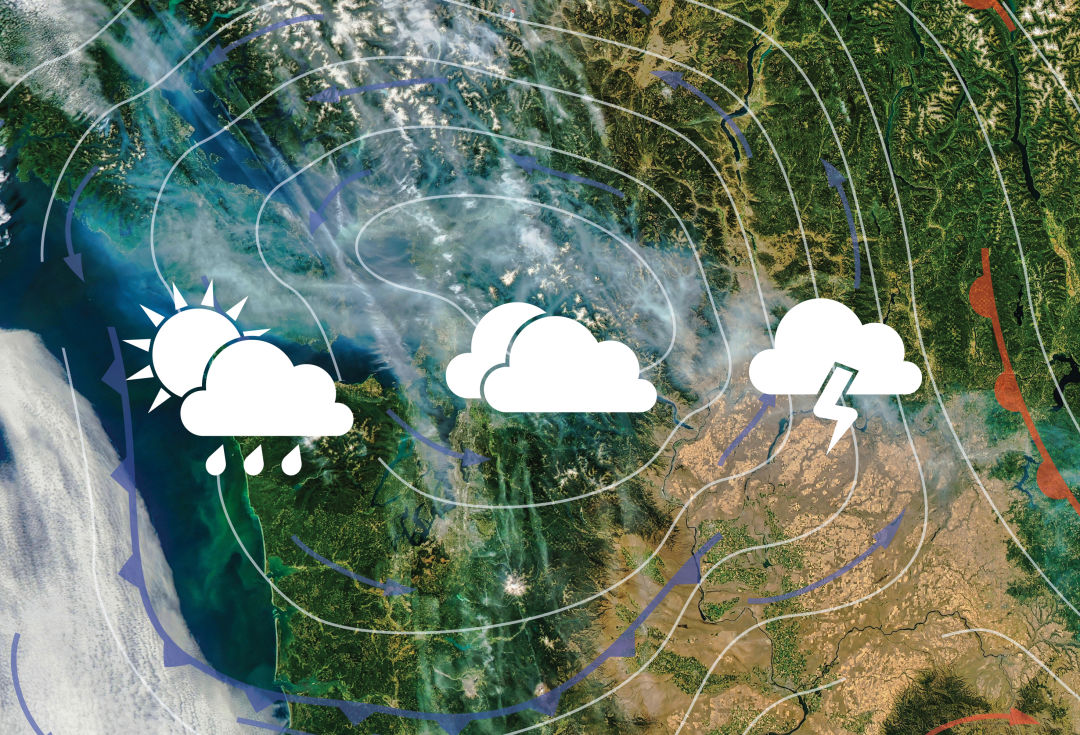
You check the weather report and it says it’s raining in Seattle. Or sunny in Seattle. Or something in Seattle—but not the something you see outside the window. You get hyped for snowstorms that never happen. You lose sunglasses because the sun never came out when it was supposed to. Why? Because Seattle weather is difficult, for many reasons. Not just difficult to live in, but difficult to predict.
The trouble starts with the definition of “Seattle.” Since 1948, the official climate reporting site for the city of Seattle has actually been located outside the city limits, at Seattle-Tacoma International Airport—12 miles south of downtown. At the time, there was a really good reason for recording the weather there.
“Planes need really precise weather information to land safely,” says Logan Johnson, meteorologist in charge at the National Weather Service’s Seattle office. But those 12 miles make a big difference.
Downtown Seattle receives about 10 percent less rainfall than Sea-Tac Airport each year due to the placement of the Olympic Mountains, which partially shield the city from storms rolling in off the Pacific; the rain shadow difference in precipitation increases the further north and west one travels from the airport.
It’s not unusual for areas south of I-90 to get around twice as much rain as their northern neighbors on particularly stormy days. Which means that “Seattle” can record historically rainy days even as the drizzle at the NWS office in Sand Point is nothing extraordinary. (They do measure there, too.)
And the airport’s automated recording equipment, called ASOS, is in a particularly brutal spot, sitting between two of the hot concrete runways at Sea-Tac with no vegetation nearby. On summer days, afternoon temperatures are typically 3 to 4 degrees warmer than those, say, near the Space Needle. The airport is also at 432 feet of elevation, much higher than downtown. As a result, the official Seattle statistics can make it look like a hotter, snowier, wetter, and generally more extreme place than it really is.
But the airport measuring system—common across the country—isn’t totally why it’s so hard to define what Seattle weather really is.
“We have a super complex terrain here. And this is what’s very different from almost anywhere else in the United States,” says Johnson. Seattle isn’t like the Midwest, where a whole city is at the same elevation; Western Washington’s terrain goes from sea level to 14,400 feet at the top of Rainier in just a few dozen miles. In between, there are a million different hills, dips, and shorelines.
It can be snowing on the top of Queen Anne Hill while it rains at Lumen Field; even with the finest-tuned weather modeling, says Johnson, it can be impossible to tell whether a commute is going to be a blizzard or a deluge. “It’s a very small error that creates a tremendous difference in impacts.”
One of the more famous examples of this is the Puget Sound Convergence Zone—a narrow area of clouds and precipitation that typically picks on areas from downtown Seattle north to Everett. During the spring and summer, this can actually make the northern half of Seattle wetter than the airport—and snowier in the winter.
But the accuracy of weather forecasting has improved, notably when NWS models have been updated, says Johnson. At the turn of the century, meteorologists could predict tomorrow pretty well, while 25 years later five-day forecasts are fairly reliable. A new AI model was launched in December, but it’s not like the experts are asking ChatGPT if it’s going to rain; the AI version is built on the same traditional global forecast system, which isn’t going away.
Maybe someday we will have individualized forecasts that can tell with certainty what is going to happen in every unique square inch of Seattle (and at Sea-Tac)—but not quite yet.
“We are trying to forecast something that is so fine-scale, the fact that we can even get remotely close to it is remarkable to me,” says Johnson. “I think sometimes people don’t realize we’re actually trying to forecast something that’s not fully predictable.”