

Over the past few years, I have developed an adverse reaction to a seemingly innocuous question: “Are there any allergies or dietary restrictions?”
I pause each time I hear it, steeling myself for what might follow my reply.
Sometimes, it’s laughter. Say from someone who knows me well enough to have read my cookbook—with its slow-roasted salmon covered in chimichurri on the cover—but not to have been updated on my ongoing medical saga. Other times, it’s disbelief, as from the sushi host who presumed I just don’t like the Northwest’s star seafood. “But the chef gets this straight from a fisherman up in…,” he started. I may have looked a little too intrigued that time, because I do love salmon. Thankfully, my best friend cut him off, reminding me it’s not worth getting sick over. “Oh,” the host said, a bit startled. “It’s an actual allergy!”
While writing The Pacific Northwest Seafood Cookbook, I ate a school’s worth of salmon—in chowder, potpie, as salad, and seared with crispy skin. Now, just a few bites can doom me to a night in the bathroom (both ends, aren’t you glad you asked?), full-body hives, and a slew of other side effects that worsen each time. The food that so many people, both personal friends and outside observers, most closely associated with me, betrayed me with the speed and ferocity of a scorned Real Housewife.

For most people, there are far worse fates than an adult-onset allergy, and far worse things to which to be allergic. Salmon is expensive, so chefs rarely sneak it into something where I might be served it undetected. It’s divisive enough (see sushi host’s assumption, above) that I’m unlikely to end up in a situation lacking other options. Outside of the Pacific Northwest, I barely need to mention it. (Another person who laughed at my response to the allergy question was a waitress at a barbecue joint in San Antonio.)
But most people didn’t write a cookbook all about Pacific Northwest seafood. Most people don’t eat and talk about the local cuisine every day for their job. Other people have allergies, obviously, but they don’t all come with a special bonus identity crisis.
In my early days as a food writer, a friend and I chatted about the concept of personal branding and I exited the conversation with a brazen, declarative slogan for myself: the world’s most enthusiastic eater of everything. It summed up my personal curiosity to know everything about food and my wannabe-Bourdain attitude toward eating. Omnivorous and ravenous, I learned by tasting without limits. The answer to that not-yet-weighty question about allergies was always a resounding “no!”
It was a form of petit-invincibility. I couldn’t know everything or be the best at anything, but my combination of youthful exuberance and iron stomach meant I could—and would—eat everything. I sampled uncleaned pig intestine in Laos and beef liver sashimi in a basement izakaya in New York City. I ate my way through 15 barbacoa stands in rural Mexico in a single weekend and taste-tested 30-some types of butter for an article. My voraciousness was a symbol of where I wanted to go, both physically and metaphorically—anywhere and everywhere, with nothing to hold me back.
It worked, and writing a cookbook that combined so many things I took pride in was the pinnacle. The Pacific Northwest Seafood Cookbook is a love letter to an all-encompassing version of the region’s cuisine, with recipes from its most famous chefs, and also from a Kurdish refugee I met while volunteering at local job-training program. It has 10 salmon recipes, including salmon sinigang, courtesy of the photographer’s mom. It projects the Pacific Northwest I grew up in, where friends’ dirtbag uncles brought poorly frozen salmon back from fishing trips, and it represents the Pacific Northwest I live in now, where people pay top dollar for the finest Baker Lake sockeye prepared by the culinary celebrities they see on television.
In the five months between when The Pacific Northwest Cookbook came out in 2019 and everything shut down in 2020, I lived out a lifetime’s worth of dreams: getting interviewed on Evening Magazine, my book named as one of the year’s best by a major newspaper, seeing my name on the marquee outside Powell’s Books in Portland. Me and salmon, we did this together, we were unstoppable.
One afternoon that summer, I taught an online salmon cooking class and then spent the evening hugging the cool porcelain of the smallest room in my house. Dr. Google and I figured it must be scombroid, a type of fish poisoning that closely resembles an allergic reaction—rare in salmon, though not unheard of. More surprisingly, my family ate the leftovers for dinner that night and were all fine.
The next year, I got sick again, this time after an incredible final meal before the closure of beloved neighborhood restaurant Opus Co. I, once again, appeared to have scombroid, and my husband, once again, was fine. Suspicious, if you ask me. As the scenario repeated itself every few months, I noticed it always followed meals with salmon.
I thought back to the only two other times I had what I’d thought was food poisoning. Once, I blamed the salmon tartare at a pre-theater brunch in New York City. The other time, mystery-fish ceviche I ate on the beach while backpacking through rural northern Peru. (I am certain there are worse places to be sick than while staying on the top bed of a triple bunk in a hostel where the toilet is a hole in the ground, but I’m going to avoid imagining what they are.)
It seemed increasingly plausible salmon was not only making me sick, but that it had been for years. The reaction got more severe each time I ate it, but it never lasted long. I took Benadryl, lost a day of my life to exhaustion, rehydrated, and forgot about it. Until the next time. And the time after that. Lather, rinse, repeat.
In 2022, on the ferry back from dinner at Seabird (where I had ordered the salmon tartare—in retrospect, a bad move) I began to feel the telltale lightheadedness that started each attack. Walking home from my friend’s house later, I alternated every few steps with a pause to throw up. By my front door, it was full-fledged. I slathered hydrocortisone cream over my rapidly erupting hives and told my husband to dial 911 and put his finger over the call button just in case, because my pulse felt as though it might erupt out of my brain. In my fog of drugs and misery, I finally had to admit what I dreaded most: I might be allergic to salmon.
It was time to bring in the experts. Getting an allergist appointment in Seattle is like trying to score tickets to a Taylor Swift concert and has to be done about as far ahead. When I finally made it in, they ran a slate of prick tests and declared me allergy-free—if something was wrong with me, it wasn’t an allergy and thus wasn’t their purview. I begged my physician for another recommendation, maybe to an allergist who would delight in solving a minor medical mystery that was very important only to a single person (it’s me). Somehow, my doctor had somebody in mind. Six months later, at her first opening, I went in and explained the problem. She repeated the prick test and added a blood test. Still negative.
When I went in to get the results, we chatted and I mentioned that people often ask me if it’s farmed (Atlantic) salmon making me sick, which is annoying because my book is about sustainable Northwest seafood—though I do appreciate and support the instinct to blame farmed salmon for all the woes in the world. At some point during that conversation, I realized that all my known reactions had in fact been to wild Pacific salmon. Maybe I was only allergic to the good stuff. But I didn’t know which type of salmon the allergy tests used.

Farmed, it turned out. I was certain I’d just Dr. House’d out the reason I didn’t have any answers yet. The allergist suggested I bring in a piece of wild salmon, and we would do a prick test with it. (Monthlong musical interlude because it’s impossible to get allergist appointments.)
On a Friday morning in November, I stopped at a Fred Meyer on my way to the doctor’s office and bought the smallest, cheapest piece of raw wild salmon they sold. It made me sad to buy crappy salmon, but it would have made me even more sad to spend money on good salmon I wouldn’t get to eat. I sat in the plasticky black waiting room chairs, clutching my plastic-wrapped Styrofoam tray from the fish department in my lap until they called my name. The allergist took a minuscule chunk of fish and disappeared briefly, returning with some sort of solution that she applied to my arm. We watched it for a few minutes. Then I stayed, under observation for most of an hour.
Still nothing.
“Well, it’s not anaphylactic,” the allergist told me, cheerfully. As sick as salmon made me, she was confident it wouldn’t kill me, and thus, she offered, I could safely “experiment” on my own at home, if I wanted, seeing which members of the Salmonidae family made me ill. But it already made me a little ill just to imagine sitting down to a Russian roulette of Arctic char, steelhead trout, and Atlantic salmon.
I brought the rest of the sad fillet from the allergy test home and let my husband cook it for dinner.
On television, medical mysteries intrigue doctors and draw them in, inspiring creative thinking and deep research. In reality, life as a low-stakes health puzzle was rather boring. My condition wasn’t fatal; it was a minor inconvenience, at best. There was no ticking clock counting away the hours of my life (or the episode). The allergist’s final diagnosis: a shoulder shrug, a recommendation to avoid eating salmon, and note in my medical record saying, “I’m not sure how to explain this.”
I had just turned 40 when the doctor told me that, technically, whatever I had was not an allergy. That age where everything famously starts to go wrong. When guys who run 50 miles a week sleep funny one night and wake up unable to move their neck. When I needed to make my first appointments for a mammogram and an optometrist. Technically, my not-an-allergy is unlikely to be related to aging. But untechnically, it felt like a big flashing neon sign that I was not the person I used to be.
I was the world’s most enthusiastic eater of everything; now I’m the food writer allergic to the cover of her own cookbook. Admitting that I couldn’t eat salmon meant saying goodbye to a food that I loved and the version of me that proudly created a cookbook about it. But that me was long gone, anyway. That me only had, like, two gray hairs and hadn’t yet experienced the joy of getting the eyebrows the ’90s ate tattooed back onto her face. That me still had two kids in diapers and no dog to cuddle with in the evenings.
This me sometimes asks dinner companions if I can peek inside their salmon entrée to see how it’s cooked, like a recovering alcoholic sniffing a well-aged bourbon. This me can’t eat salmon, but sometimes when I’m out of town, my husband texts me the next best thing: photos of my older daughter making her favorite dish in the world, the slow-cooked salmon with chimichurri on the cover of my book (see recipe, below).
Four years after admitting something was wrong, I’m no closer to understanding the medical reason why my body hates one of my favorite foods, but I am slightly closer to coming to terms with my body’s reaction to it—and other people’s. I no longer feel the sting of tears in my eyes when people learn of my allergy and laugh. I get it! It’s hilarious! The fish are getting revenge!
Sometimes I can even eke out a giggle, too. And I’ve found a bigger giggle and a bit of joy from the look of horror on a sushi chef’s face in the moments between reminding them of my salmon allergy and letting them know cross-contamination won’t kill me. “It’s not anaphylactic,” I tell them, cheerfully.
Slow-Roasted Salmon
Serves 4
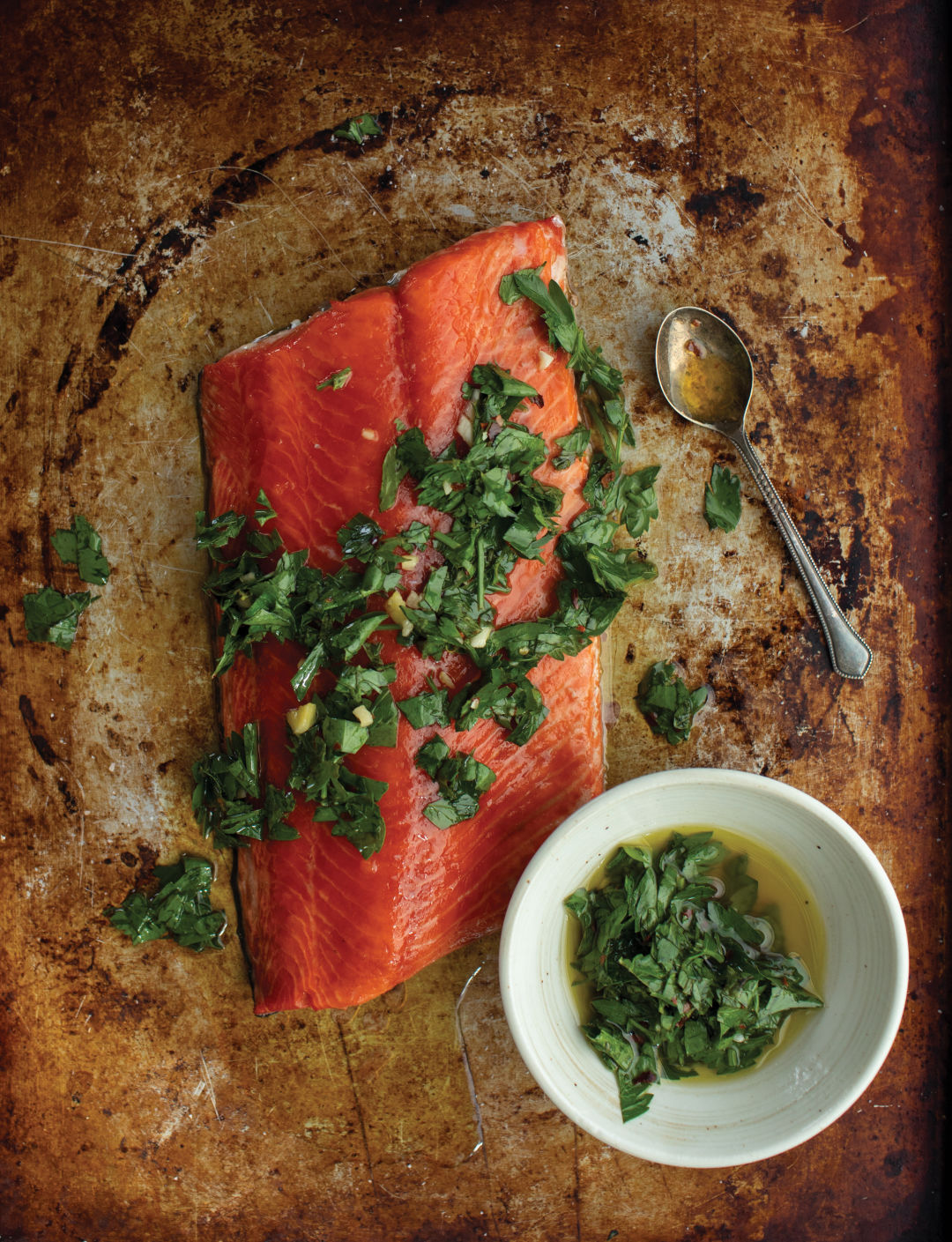
The cover model and first recipe in my cookbook—also my older daughter’s favorite meal.
The word “foolproof” gets tossed around a lot when it comes to recipes, but rarely when it comes to temperamental proteins like tender salmon. When shelling out money for a good side of wild Pacific Northwest salmon, nobody wants to take chances, though, and this truly foolproof method of cooking leaves it beautifully bright, intact, and never dried out.
This recipe works well for any size portion: Simply adjust the oil, salt, and lemon amounts to the size of the salmon. The timing stays the same, and you should have plenty of chimichurri.
- 1 lb skin-on salmon, pin bones removed
- 1 tbsp olive oil
- ¼ tsp kosher salt
- ¼ lemon
- Chimichurri sauce, to serve (recipe below)
Preheat the oven to 225˚F. Rub both sides of the salmon lightly with the olive oil, then sprinkle the salt on top. Place the salmon skin side down on a baking sheet and bake for 20 minutes. Don’t worry too much about exact timing, as the recipe is very forgiving. When the salmon is done, it may still look uncooked, as the color doesn’t change much, but don’t worry: It’s cooked. Small dots of white protein may bubble up, but they are nothing to be concerned about. Remove the salmon from the oven and squeeze lemon lightly over the top. Serve with the chimichurri sauce.
Chimichurri Sauce
In Argentina, this parsley-based sauce comes out at every parillada, or grill feast. But the sharp vinegar, piquant pepper flakes, and fresh herbs also work well with fish dishes like this one. Because you can make it ahead of time, it turns the salmon into a low-stress dinner party stunner. For any portion of salmon less than a pound, you’ll have enough left over for a second meal— simply store it in the refrigerator and use it over pasta, eggs, or shrimp.
- 3 garlic cloves
- 2 tbsp white wine vinegar
- ½ cup olive oil
- ½ tsp kosher salt
- ½ tsp red pepper flakes
- ½ cup flat-leaf parsley leaves
- 1 tbsp oregano leaves
Mash the garlic (use a garlic press, if you have one; otherwise crush it with the broad side of a knife or mince it fine) and stir it together with the vinegar in a small bowl. Slowly whisk in the olive oil, then add the salt and pepper flakes. Chop the parsley and oregano fine, then put them into a mixing bowl and pour in the oil mixture, stirring well. You can save on chopping time and make this in the food processor, with but a small loss of texture.
Photograph and Recipe reprinted with permission of Countryman Press