


Evelyn Iritani was working for the Seattle Post-Intelligencer when, investigating an early-’90s story about a Port Angeles logging mill that had been purchased by a Japanese conglomerate, she became intrigued by the Pacific Northwest’s complex relationship with Japan. The story led to Iritani’s 1994 book, An Ocean Between Us, which included multiple interviews with UW professor Richard McKinnon, an expert in Japanese culture.
During the interviews, McKinnon, born to a Japanese mother and an American father in 1922 Japan, told Iritani that he and his father were “traded back to the United States” as part of a large World War II civilian swap at the height of the Pacific Theater.
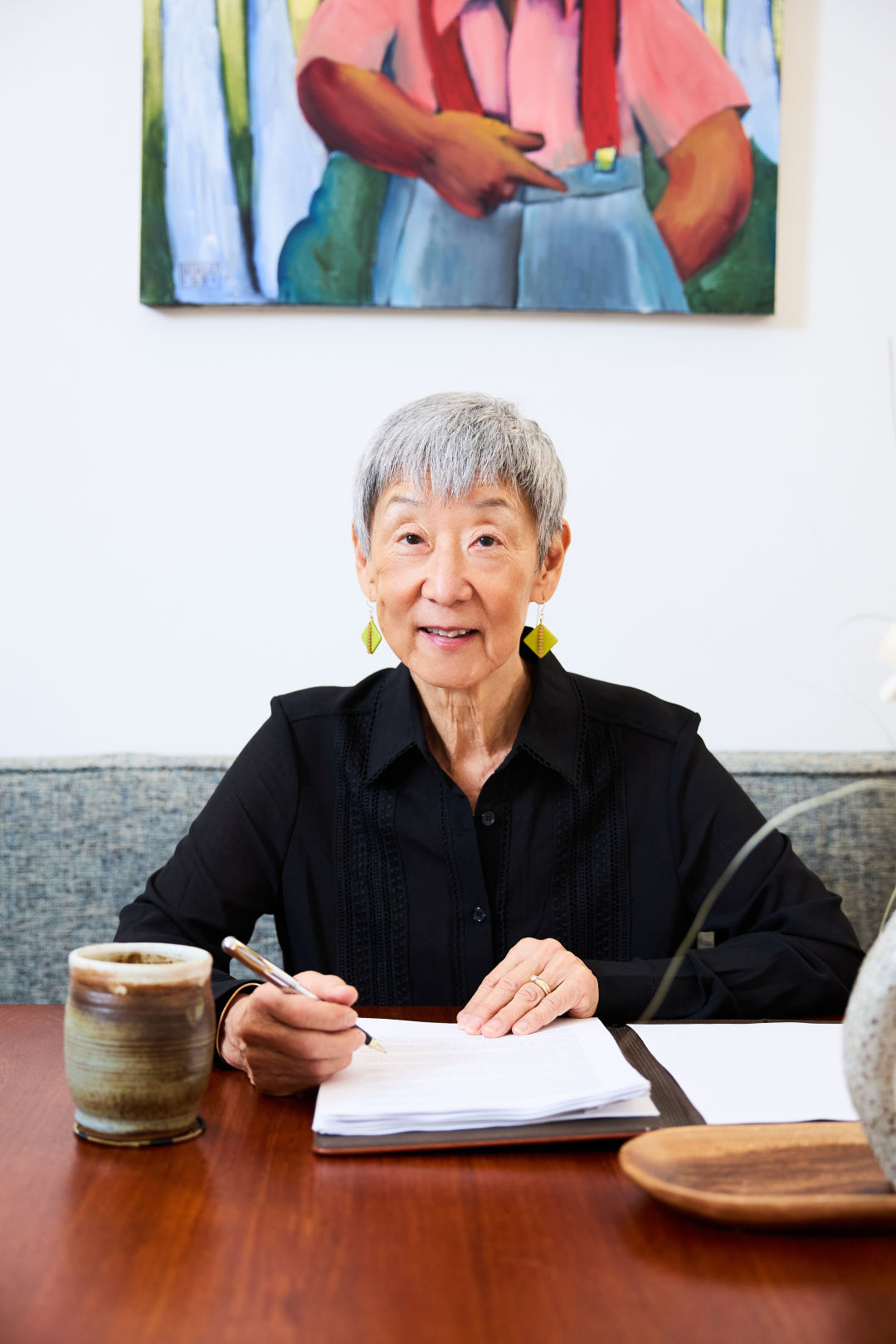
Evelyn Iritani at her home in Seattle.
“I had been reporting on US–Japan issues for some time by then,” Iritani, who is also Japanese American, recalls today. “I knew something about the relationship, but I was shocked. I had never heard of a civilian exchange during World War II.”
Iritani, a curious, clear-eyed thinker with a journalist’s disposition, soon took a job at the Los Angeles Times and moved to California. But the kernel had sprouted. Twenty years on, she returned to McKinnon’s story and assembled a book proposal that would become the most significant investigative project of her life.
Safe Passage, out March 10, is the decade-long culmination of Iritani’s research. On a superficial level, the book chronicles the voyages of the MS Gripsholm and the Teia Maru, two ocean liners used to swap thousands of people of Japanese descent in the Americas for a roughly equal number of Americans stranded in Asia after the outbreak of WWII. But the story, told from a constellation of perspectives and places, covers much more than the repatriation effort. The meticulously researched book is a poignant reminder that even in moments of international strife, there are people in and outside of government who will work hard to protect human life.
“There were times along the way when I thought about quitting,” says Iritani, now 70. “I really struggled with the narrative, on different ways to tell the story. For the people who had been involved with the exchange, this was a very painful piece of their past, and they had rarely talked about it with anyone, even their family. So I felt that I had a responsibility to tell these stories.”

During World War II, American and Japanese civilians were transported between countries on ocean liners.
The protagonists of Safe Passage include James Hugh Keeley, a diplomat working in the US Special War Problems Division; Don Hasuike, an American-born Angelino forced into Colorado’s Camp Amache and then onto the MS Gripsholm; and Emily Hahn, a New Yorker journalist caught in Hong Kong when the Japanese invaded in 1941. Also included are multiple American teachers working in Japan—including McKinnon’s father, Daniel Brooke McKinnon—and an unlucky group of Japanese Peruvians, who, used as bargaining chips by two major powers, got the shortest shrift of anyone involved.
“As long as people have been at war,” writes Iritani, “there have been prisoners to be held hostage, sold, traded, killed, or simply put on display as the most exotic of war trophies. And along the way, concepts and customs about the proper treatment of prisoners have been transformed into legal doctrines whose goals are to save lives, alleviate suffering, and protect those offering assistance to the wounded.”

In Safe Passage, Iritani emphasizes the 1929 Geneva Convention on Prisoners of War. The United States signed and ratified the document. Japan did not, but made verbal agreements to honor the law. “What I didn’t realize,” says Iritani, reflecting on her research, “was how important it was for diplomats like James Keeley to have these, so that they could push Japan on, say, accepting and distributing aid packages.” The Geneva Convention worked the other way, too. When Japan complained that its civilians had been shot at American internment camps, Keeley pressured the American military to commit to warning shots during possible escape attempts. He also made multiple tours of the camps to verify their conditions for the Japanese government.
Through an international diplomatic structure known as the protecting powers mandate, both America and Japan used intermediary third-party countries to communicate during wartime. The US channeled its communications to Japan through Switzerland. Japan reached America through Spain. There were inefficiencies with this system, but it generally worked, even amid the fighting. “That’s one of the most important takeaways for me: civilized warfare,” says Iritani. “Keeping communication lines open makes the world a safer place. Cooperation rather than force, commitment to rule of law. You see in this book what happens when they stray from those laws.”
Exploring these stories through a civilian and bureaucratic lens, Iritani crafts some novel and relevant interpretations of the Pacific War. One of her evaluations is that, though it was “not singularly a race war,” the struggle manifested many of the symptoms associated with one. Racial propaganda raged on both sides of the Pacific, flaring up in vicious cycles when incidents arose. As shown by the exchange of the Peruvian Japanese—roped into repatriation as their new government sought to please American officials—national preference and immigration status meant little if your skin color didn’t fit the bill.
It’s impossible not to think about the cruelty of contemporary US policy and politics when reading Safe Passage. But the book still manages to end optimistically. “Of the 124 Japanese American children repatriated to Japan on the Gripsholm exchanges, 108 eventually made their way back to the United States,” writes Iritani.

Which is to say that even after being interned in desert camps by their own government, and then being shipped across the world’s largest ocean to cities that that government was actively bombing, most of these young Japanese Americans Iritani writes about decided to give the US a second chance. It’s the long arc of history that ultimately makes Safe Passage a hopeful book, and a powerful antiwar plea in a year desperately in need of one.
Evelyn Iritani celebrates the launch of Safe Passage on March 10 at 7:30pm at Town Hall in conversation with civil rights activist Frank Abe. She will also be reading at Third Place Books, Lake Forest Park, at 7pm on Thursday, April 2.