

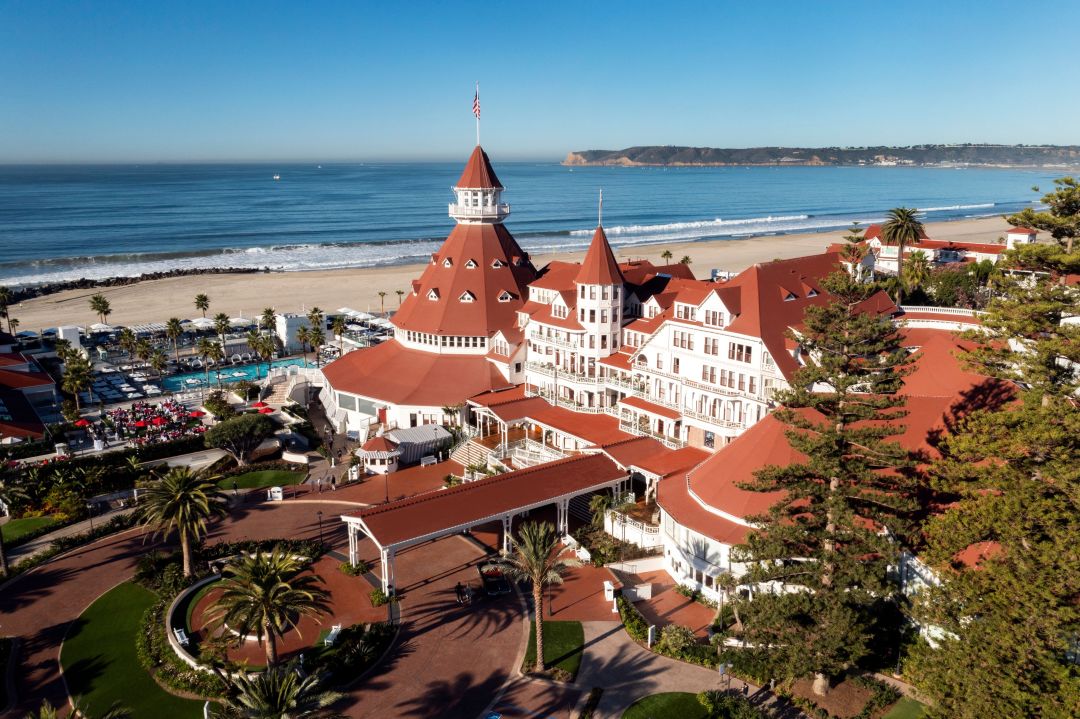
The Hotel Del Coronado is famous for its red roof, which sits between San Diego and the Pacific Ocean.
When construction workers peeled away a section of old ceiling in the entryway of the Ocean Ballroom at the Hotel Del Coronado a few years ago, they spotted what looked like old wallpaper underneath. Pastel flower blooms spread across a blue background, ringed by decorative vines. When hotel historian Gina Petrone was called in to eyeball the exposed flowers, she immediately recognized that she was looking at a hand-painted fresco, painted on the ceiling as much as a century before.
It took more than six years to renovate the Hotel Del Coronado, and surprises like that popped up throughout the process. The little treasures and unexpected gifts dated back as far as 1888, when the hotel opened on an island off San Diego. In preparation for the grand reopening last summer, stained glass was painstakingly preserved; one window was removed in 725 individual pieces before reassembly. Chandeliers were replaced and in the Ocean Ballroom, art conservationists carefully exposed and restored the old fresco. Call it regilding the Gilded Age.

Though the Hotel Del Coronado predates color photography, what's most notable is how little has changed since the 1880s.
“We had no idea it still existed,” says Petrone, staring up at the ceiling. But she can point to many signs of the old iterations of the famous Del, from the footprints of the old swimming pool (smaller than today's), to where the beach was extended as San Diego harbor was dredged and the sand washed up on the hotel's front door. “With hotels, it's easier to cover up things rather than tear stuff out,” she says, so the hotel's long history was often just underfoot.
The $550-million spruce-up also fixed some, well, bad choices. Shortly after Marilyn Monroe, Jack Lemmon, and Tony Curtis filmed Some Like It Hot in 1958—the Del, as it's known, stood in for the movie's Florida setting—the signature front porch was dismantled in a renovation. This last undertaking replaced it.
The Del is so close to Mexico that the lights of Tijuana are just down the shoreline after the sun dips behind the Pacific. Though hundreds of rooms have been added in the past century, including multi-room villas, it opened with 450 rooms in 1888—especially massive given that San Diego was a new boomtown at the time; the railroad had just arrived a few years before.
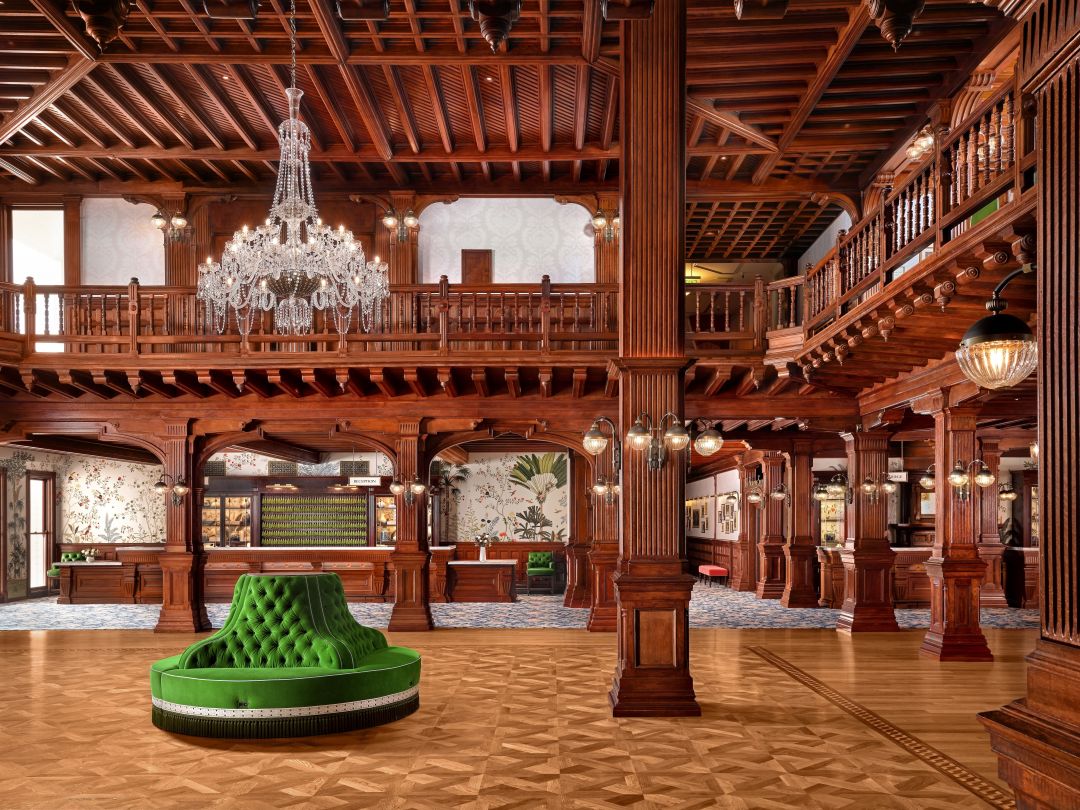
The Hotel Del's renovated lobby includes new hand-painted wallpaper inspired by the jungle-like courtyard.
Now the hotel itself is a permanent boomtown; its walkways and lawns get as crowded as Disneyland on weekends, and lines for the gelato shop spill outside. It's remarkable how isolated the resort feels despite sitting a 15-minute drive from the airport, largely because most sight lines point west toward the beach. The main building, now called the Victorian, retains its signature red roofs. The original oak-walled interiors and an interior courtyard give it continental vibes. It was billed as the largest resort in the world when it opened, and it still feels like it could make a bid for the title.
Coronado is home to several hotels, but the Del is its own thing. There's the name, for one; Petrone says the nickname isn't original, but these days calling it “the Coronado Hotel” or something similar will earn a blank stare from any Southern Californian. It's just “The Del” (which would translate to “the the,” notes Petrone). There are almost as many myths as historic facts about the place; though L. Frank Baum was a longtime visitor, he did not base Oz on these turrets and ballrooms, as is often claimed.

At one point, the hotel kept pet monkeys in the courtyard.
What has stuck throughout all 138 years of operation is the luxury price tag; post-renovation, room prices start around $500 and mostly soar into four figures. I heard the words “sticker shock” said aloud by guests in passing. Even expecting a high-end price tag, I also couldn't quite believe the $12-per-taco Taco Shack, even with their handmade white and blue corn tortillas.
Most add-on experiences utilize the ocean, sunsets, and plentiful San Diego sunshine—shaded chairs, s'mores roasts, a beachfront ice skating rink in winter. But it's the renovated Victorian building that feels most remarkable. Despite being the inspiration for Disney World's own Grand Floridian Hotel, the Del feels grand on a scale no modern hotel builder could conceive. The hallways are endlessly long, quite obviously home to a resident ghost. Rounded pathways and circular rooms, underground tunnels and tiny staircases turn the whole place into a labyrinth. You could spend a weekend here and barely notice that the rest of Coronado Island existed, much less the rest of San Diego.

From the air, it's easy to see how much of Coronado Island is devoted to naval bases.
But even though I sought out the Del for a car-free vacation from Seattle (ideal, as it turns out), it's best enjoyed with the rest of Coronado Island. At about 13 square miles, Coronado is actually a peninsula that fits like a wine stopper into San Diego Bay. Three different military installations take up more than half the land, including naval and amphibious bases, and scenes from both Top Gun movies were filmed here.
The Del sticker shock recedes quickly across the street, even in spaces almost as historic. The signature red roofs of the Del are visible from the patio of the Glorietta Bay Inn, built into the 1906 mansion of one of the Del's founders, John Spreckels. It's delicate where its neighbor is bombastic, and its pool is infinitely calmer than the one across the street.
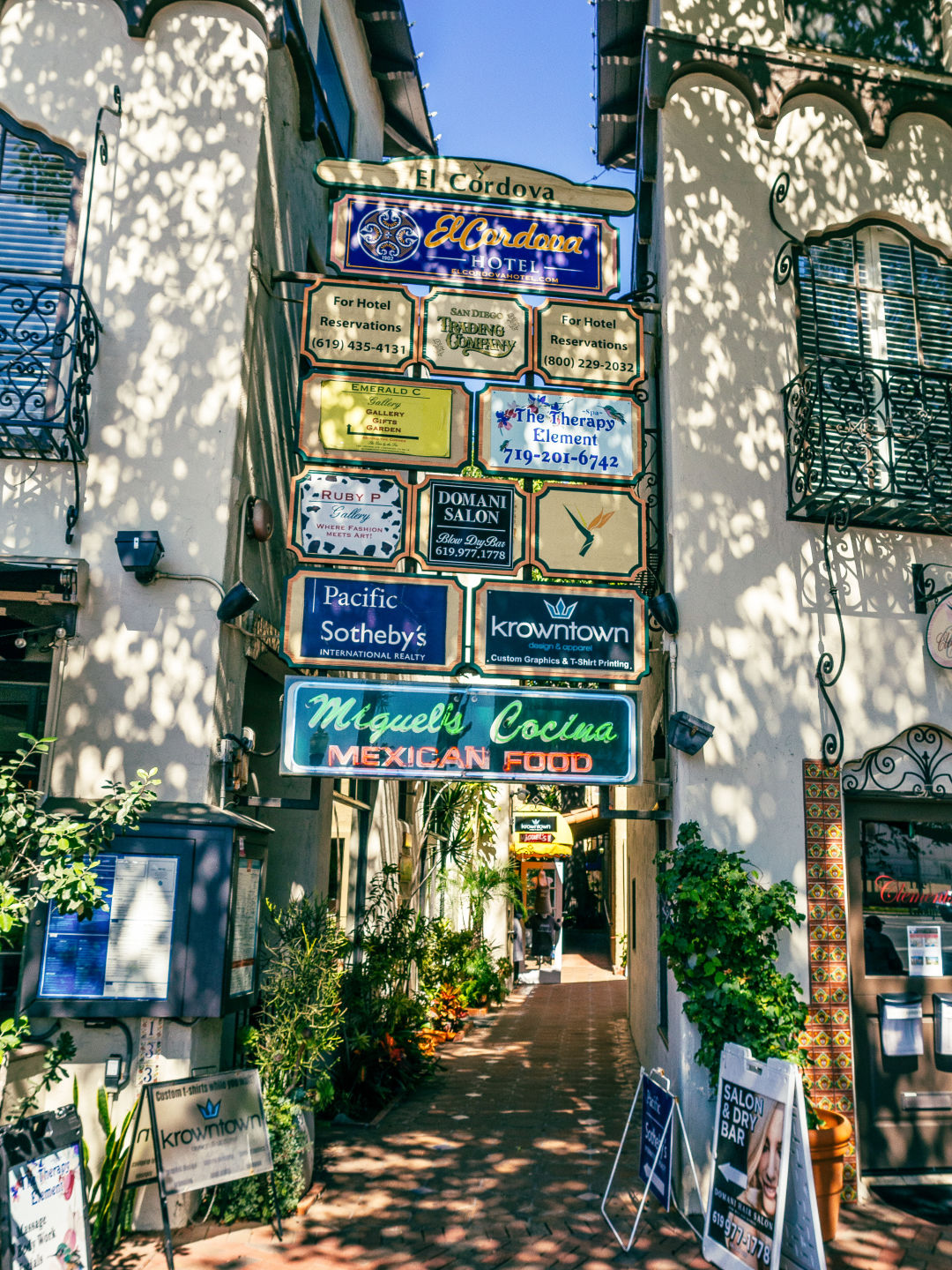
Across the street and down an alleyway, Miguel's dishes classic SoCal Mexican.
But some parts of Coronado are the complete opposite of the Del's preening grandeur. Down an alleyway just across from the big resort, Miguel's Cocina dishes big baskets of tortilla chips and a signature white cheese sauce on an outdoor patio, along with pleasantly cheap fish tacos and pint-size margaritas. At the Night and Day Cafe, itself almost a hundred years old, a short-order cook throws eggs and bacon on the grill all day. Little of Coronado is more than a walk or stumble away.
The military looms larger than even the tourists who flock to Coronado. Up the street, McP's Irish Pub explicitly celebrates US Navy SEALs (it was founded by one) with mug club vessels hanging from the ceiling above the bartenders. The Urt Urt T-shirt shop, named for a different kind of seal (just say the name aloud), specializes in surf wear with explicit but irreverent navy references, like a schematic of Osama Bin Laden's compound raided by a SEAL team.
It all makes for a lot of American culture in one small footprint. Back at the Del, one corner of the gift shop is devoted to Kate, that resident ghost. She was a guest who checked in under a fake name in 1892 before killing herself, and she's said to haunt the hotel in a dramatic black dress. It's still a mystery why she took her own life, but her afterlife makes sense; if you were going to stroll for eternity, you could do much worse than Coronado.