

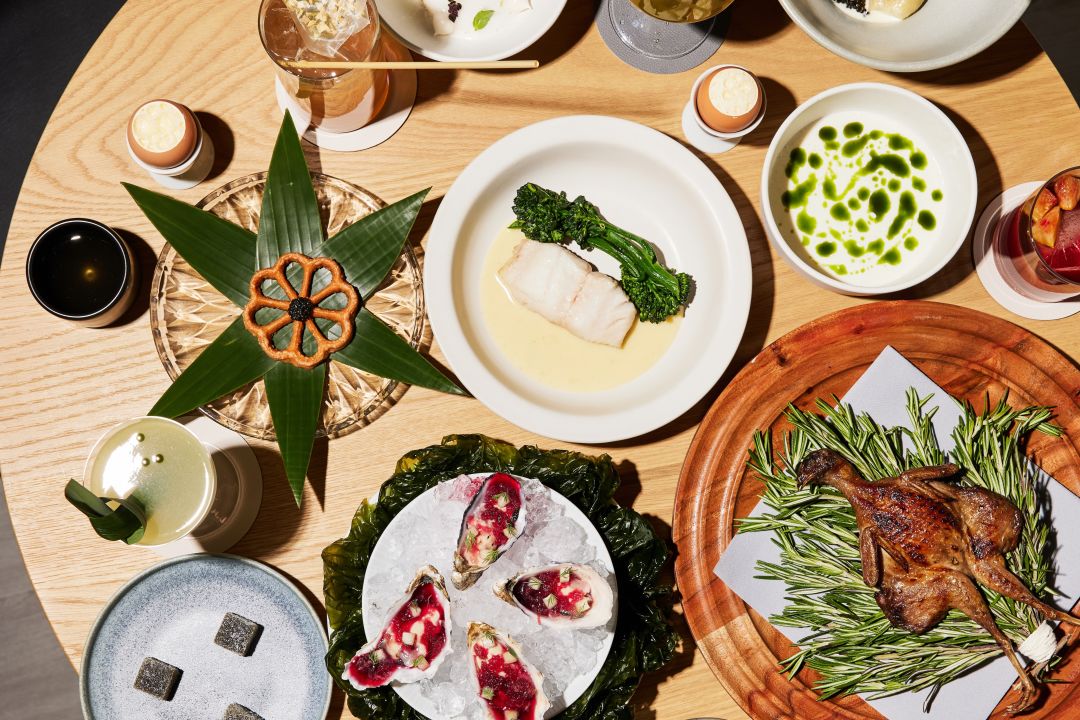
The food at Ilmu, when available, is some of the most exciting and creative in the region right now.
The kuih goyang—crispy Singaporean rice flour rosette—stuffed with spicy fish paste and topped with osetra caviar haunted my memories since last summer. I finally snagged another reservation at Bothell’s Ilmu in March, but when the rosette arrived, the fourth of more than a dozen courses, it lacked the otak otak-filling I remembered, inspired by Malay fish cakes. In its place, a miso crème fraîche, cool and creamy and full of umami, held together the pieces of the dainty cookie as it shattered. Chef Fairoz Rashed managed to take one of my favorite dishes of last year and make it even better.
Those who know Rashed’s story and his ability to iterate, innovate, and cook like hell will not find this surprising. Arriving in the US with a Michelin star-spangled resume, he found himself rejected from places that matched his experience, like the French Laundry, and accidentally became a baker. At Ilmu, Rashed and his wife, Katie Fairoz, channel more than a decade of creativity stifled by immigration difficulties, pandemic pivots, and the double-edged sword of viral success into a dozen courses of precision, whimsy, and beauty.

Ilmu improves upon its amazing kuih goyang, now with miso crème fraîche and chives.
“We almost named the restaurant the Pigeonhole,” says Fairoz. “That’s what everybody wants to do, right? They want to stick you in a box, and you live in that box, and that's just never going to be us. We want to live outside the box.”
Released from the limits of SuSu—their Seattle rolled ice cream stand and, later, Chinatown–International District bakery—and T55 Patisserie, the Bothell bakery inside which Ilmu operates, Rashed’s culinary curiosity froths and gurgles. Sometimes literally, as in the amuse bouche in a Nick and Nora glass, that bubbles up infinitely: Strega Nona’s pot if it were filled with apple juice and fir tree honey. “You’re not going to be drinking it,” Fairoz warns as she brings it to the table. Instead, I use my spoon to lift the bubbles, like a kid in a bubble bath, letting them explode with sweetness.
It is the kind of thing that, at the wrong place in a menu or combined with other dishes teetering on the precipice of absurdity, could tumble from the heights of innovation into the chasm of satire. Each time a course teeters over that edge, the next dish employs advanced techniques in the service of simplicity, tottering it back to safety with a bowl of soul-satisfying dashi or a hearty fillet of grilled black cod.
Ilmu is a rare gem; fascinating, infuriatingly good, and frustratingly limited. Since it first opened, about a year ago, it closed for three months due to staffing issues, and has offered only one or two meals a week. All at unconventional times, like 2:30 on a Saturday afternoon, or 11 on Sunday morning—an hour more common for hangover-quenching brunches than a parade of courses that kicks off with three amuses bouche.

A palate cleanser of coconut pannacotta with Thai curry water and lime sorbet.
The name Ilmu comes from a Malay term that loosely translates as “the search for knowledge,” and that applies both to the kitchen and the customers, who are not casual observers looking for something new to do with their Friday night, but committed gastronomical thrill-seekers willing to schedule their weekend around their reservation.
There is no menu; each dish arrives with surprises in tow, and every bite reaches for something new—in format, flavor, or with obscure ingredients. Over the dozen-plus courses, the food meanders through cuisines, drawing heavily on the cuisine of Rashed’s Singapore upbringing and the French techniques of his fine-dining career.

Ilmu's version of the Lunar New Year salad lo hei
The first few dishes are ultra-light, just a single bite of chocolate tuille with apple, shiso, and basil inside, or an oyster with hibiscus granita, pickled cucumber, and oxalis. The meal advances with a steady rhythm, the portion sizes growing, the ingredients expanding, stretching out the idea of what makes a meal.

If you've never slurped spicy seafood water out of a pepper through a fennel straw, Ilmu can fix that.
In March, a pair of salad courses included triple-grilled French green beans tossed in yuzu soy sauce and topped with butter foam, and a take on lo hei, a typical Lunar New Year dish. Matchsticks of carrots and jicama sat amid a rainbow of dollops—black sesame seeds, pale pink pomelo, cucumber sorbet the shade of wasabi, housemade hoisin sauce, and smoked trout roe. It arrived festooned with patterned purple nasturtium leaves and accompanied by instructions to toss the ingredients in the air to mix them, as per tradition. “It’s just a way to ring in the new year and ask for health, happiness, and prosperity,” Fairoz explains excitedly. Though the setting is casual—a few tables in a closed bakery—Fairoz leads a warm, elegant, and blessedly unserious service, during which she radiates a genuine and contagious enthusiasm about each dish.
Between the two salads, I sip a spicy, clear liquid through a fennel straw from a hollowed-out green pepper stuffed with herbs. Based on a ceviche-like Malay dish called ikan kerabu, it packs a powerful marine punch from red snapper and clams, laced with the fire of habanero peppers, yet remains bright and refreshing. The flavors and ingredients all ring familiar, the format novel.
Skewers of chicken satay, a staple of Singapore, are rendered particularly tender by a two-step cooking process—deep fried, then grilled over charcoal, the latter erasing the telltale greasiness of the former. The spicy peanut sauce leans classic; the pickled Korean pears replacing the usual cucumbers and a garnish of butterfly sorrel decidedly not.

Rashed's chicken satay takes liberties with the classic Singaporean dish.
Ilmu’s stumbles are few, minor, and far between—the biggest disappointment of my first meal was an add-on steak tartare that was simply quite ordinary; at the second, an awkward sea urchin bite on brioche toast that involved spherified peas. Rather, the only true mark against the restaurant is that it only barely exists.
Reservations go up once a month, and when they do, the price is right. In an era where any sit-down meal seems expensive, $125 for a dozen courses of the most innovative cooking around constitutes a screaming deal. Fairoz admits the current format doesn’t actually turn a profit—more prototype than final form. Based on my experience with the rosette, I have faith in the restaurant to improve itself in each iteration. (For example, plans for a weekday afternoon social hour with à la carte menu later this month.)

Once a week, Katie Fairoz and Fairoz Rashed transform their Bothell bakery into a fine-dining restaurant.
It is a restaurant built as an outlet for Fairoz and Rashed’s own ilmu—the search for knowledge, remember—and for diners to eat somewhere rewarding of their own culinary curiosity. Ideally, through an Apple Jacks-inspired après-dessert custard served in an eggshell with apple compote and black truffle cream.
Impressively, despite the ongoing permutation and drive toward the leading edge, nothing about Ilmu feels experimental. Molecular techniques seem essential and integrated; dishes are refined and meticulous. The restaurant feels smart and educated, the menu as though designed by someone who ate at a million fine-dining restaurants and set out to find a way to retain the best parts and reject the outdated or uncomfortable ones.
Even inside the necessarily casual bakery setting, it holds onto the best formalities of fine dining—gentle pacing, purposeful and precise dishware, a short but intriguing wine list, and tiny delights like post-meal pâtes de fruits—to evoke the kinds of restaurants for which diners pay hundreds of dollars. The kinds of meals around which people plan trips to Napa Valley, Basque Country, and Copenhagen. Seattleites just have to—and should—make the trek to Bothell.